
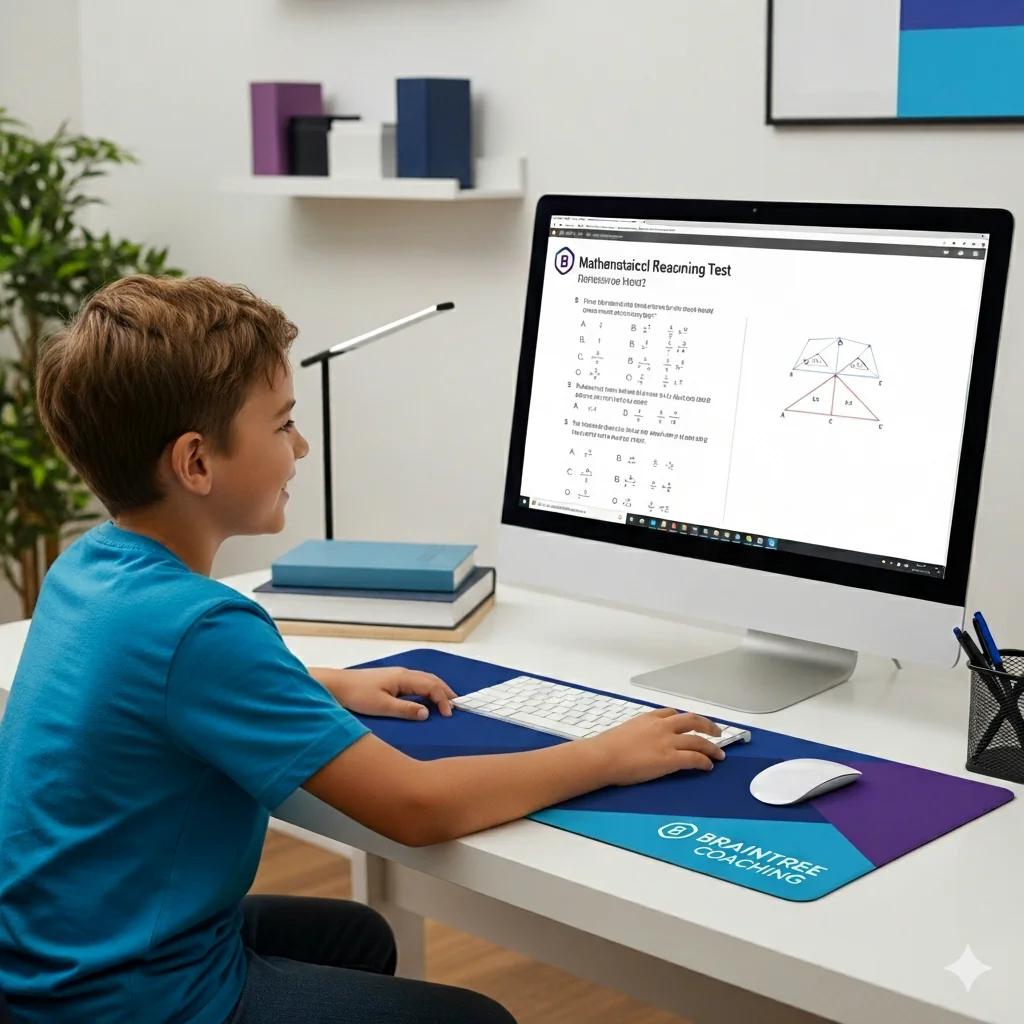
"Finding quality free practice materials for the OC test mathematical reasoning section was a game-changer for our preparation. The downloadable questions helped my child understand exactly what to expect on test day." — Sarah Chen, Parent of 2025 OC Success Story
The NSW OC Mathematical Reasoning Reality: Free Practice Makes Perfect
The opportunity ahead: NSW Opportunity Class mathematical reasoning assessment challenges students with pattern recognition, logical problem-solving, and multi-step thinking processes. Free practice resources provide essential exposure to authentic question formats without initial financial investment.
🎯 In this comprehensive guide, you'll discover:
- Free downloadable OC practice test PDF with 10 mathematical reasoning questions and complete solutions
- Current 2026 OC test format details for mathematical reasoning component requirements
- Step-by-step solving strategies for each mathematical reasoning question type
- Pattern recognition techniques that appear most frequently in OC testing
- Advanced preparation pathways using computer-based exam format practice
- Long-term success strategies for transitioning from free to comprehensive preparation materials
Navigate through all sections for comprehensive preparation insights
Click any section above to jump directly to that content
Starting your NSW Opportunity Class test preparation journey with free mathematical reasoning practice tests provides valuable insight into actual assessment expectations while building foundational confidence. This comprehensive guide explores how to maximize free resources before advancing to comprehensive computer-based preparation programs that mirror the actual 2026 OC testing experience.
Understanding the NSW OC Test Format 2026
2026 OC Test Key Details
The NSW Opportunity Class test 2026 is entirely computer-based, conducted at external test centres from 2-4 May 2025. All questions use multiple-choice format across three components: Mathematical Reasoning (40 minutes), Reading Comprehension (30 minutes), and Thinking Skills (30 minutes).
What Makes the Mathematical Reasoning Component Unique
The NSW Education Department emphasizes critical thinking and analytical reasoning over curriculum memorization in the 2026 OC test format. Mathematical reasoning questions require students to apply logical thinking processes, recognize patterns, and solve multi-step problems using reasoning rather than rote calculation.
Key 2026 Mathematical Reasoning Features:
- Duration: 40 minutes for approximately 35 questions
- Format: Multiple-choice questions with options A, B, C, D, or E
- Focus: Pattern recognition, logical deduction, and problem-solving processes
- Technology: Computer-based delivery with on-screen calculators not provided
- Emphasis: Reasoning abilities rather than computational speed or memorized formulas
How Mathematical Reasoning Fits Within Overall OC Assessment
Mathematical reasoning represents one of three equally weighted components in the NSW OC placement test 2026. Students must demonstrate competency across all areas, making balanced preparation essential for overall success.
The mathematical reasoning component specifically evaluates students' ability to think mathematically about problems, identify underlying patterns, and apply logical reasoning to reach correct conclusions within time constraints.
NSW OC Test Component Breakdown
Understanding the complete assessment structure for 2026
Mathematical Reasoning
Reading Comprehension
Thinking Skills
Total Test Duration
Mathematical Reasoning Deep Dive: Question Types and Assessment Focus
Core Mathematical Reasoning Skills Assessed in 2026
The NSW OC mathematical reasoning component evaluates specific thinking skills that demonstrate high-ability learning potential across mathematical contexts.
Primary Skill Areas:
Pattern Recognition and Sequences: Students identify underlying rules in numerical, geometric, and logical progressions. Questions present sequences where students must determine the next term or missing element based on identified patterns.
Spatial and Visual Reasoning: Three-dimensional thinking, mental rotation, and geometric relationship understanding. Questions involve shape manipulation, visualization of transformations, and spatial pattern completion.
Logical Problem-Solving: Multi-step word problems requiring systematic analysis, strategy selection, and solution verification. Students must extract relevant information and apply appropriate mathematical reasoning processes.
Proportional and Relational Thinking: Understanding ratios, percentages, scaling relationships, and comparative analysis across different mathematical contexts and real-world applications.
Mathematical Reasoning Question Categories Explained
Mathematical Reasoning Question Types vs Traditional Math
Understanding the critical difference for OC success
| Feature | Option 1 | Option 2 | Verdict |
|---|---|---|---|
| Number Patterns | Memorize multiplication tables | Identify underlying pattern rules and logical relationships | Reasoning over memorization |
| Word Problems | Apply standard formulas | Analyze context and develop solution strategies | Process understanding essential |
| Geometric Thinking | Calculate area and perimeter | Visualize transformations and spatial relationships | Spatial reasoning focus |
| Data Analysis | Read numbers from charts | Interpret trends and draw logical conclusions | Critical analysis required |
Advanced Mathematical Reasoning Concepts for High-Ability Students
OC mathematical reasoning questions challenge students beyond standard Year 4 curriculum expectations, requiring flexible thinking and creative problem-solving approaches.
Complex Pattern Recognition: Multi-step sequences involving combined operations, geometric progressions, and abstract logical relationships that require several reasoning steps to identify correctly.
Advanced Spatial Reasoning: Three-dimensional visualization, mental rotation of complex shapes, and understanding of perspective changes across different viewing angles.
Meta-Cognitive Problem Solving: Questions requiring students to think about their thinking processes, evaluate multiple solution pathways, and justify reasoning approaches.
Free Practice Test Resources: Your Starting Point for OC Success
Accessing Quality Free OC Mathematical Reasoning Questions
Free Practice Test Access
Access your free OC and Selective School practice test pack including mathematical reasoning questions with complete solutions at: https://classroom.braintreecoaching.com.au/learn/free-test-pack
What's Included in Free Practice Resources:
10 Mathematical Reasoning Questions: Carefully selected problems representing the range of difficulty and question types students encounter in actual OC testing.
Detailed Solutions and Explanations: Step-by-step solving processes that demonstrate effective reasoning strategies and common problem-solving approaches.
Downloadable PDF Format: Convenient offline access allowing students to practice under realistic conditions without screen distractions.
Answer Analysis: Explanation of why incorrect options appear plausible and how to avoid common reasoning errors during actual testing.
Maximizing Free Practice Test Benefits
Strategic Practice Approach:
Begin with untimed practice to understand question formats and reasoning requirements. Focus on understanding problem-solving processes rather than speed completion during initial practice sessions.
Error Analysis Implementation: Review incorrect answers immediately after completion, identifying specific reasoning gaps or pattern recognition difficulties that require additional attention.
Pattern Identification Practice: Use free questions to identify recurring themes, common mathematical reasoning types, and typical complexity progressions found in OC assessment.
Baseline Assessment Establishment: Use free practice performance to establish current ability levels and identify specific mathematical reasoning areas requiring focused preparation.
Free OC Preparation Resources
Start your preparation journey with quality free materials
Free OC Practice Test Pack
10 mathematical reasoning questions with detailed solutions and explanations
Access ResourceNSW Education Department Sample Questions
Official sample questions showing authentic test format and presentation
Access ResourceUnderstanding Limitations of Free Resources
Scope Considerations: Free practice materials provide valuable introduction to OC mathematical reasoning but represent limited exposure compared to comprehensive preparation requirements.
Depth Requirements: Successful OC preparation typically requires extensive practice across multiple difficulty levels, question variations, and time management scenarios.
Computer-Based Format Preparation: Free PDF materials don't provide experience with actual computer-based testing conditions, which require separate preparation focus.
Question Types and Solving Strategies: Mastering Mathematical Reasoning
Number Pattern and Sequence Questions
Pattern Recognition Strategies:
Linear Patterns: Identify constant differences between consecutive terms. Example: 3, 7, 11, 15... (difference of 4 each time).
Multiplicative Patterns: Recognize constant ratios or exponential relationships. Example: 2, 6, 18, 54... (multiply by 3 each time).
Complex Combined Patterns: Multi-step rules involving addition, multiplication, or alternating operations. Example: 1, 4, 9, 16, 25... (perfect squares sequence).
Systematic Pattern Recognition Approach
Examine Differences
Calculate differences between consecutive terms to identify linear patterns
Check Ratios
Look for multiplicative relationships when differences vary significantly
Consider Combined Operations
Test hypotheses involving multiple mathematical operations or transformations
Verify Pattern Consistency
Confirm identified rules apply throughout the entire sequence
Multi-Step Word Problem Solving
Systematic Problem Analysis:
Information Extraction: Read problems completely, identifying given information, unknown quantities, and specific questions asked.
Strategy Selection: Choose appropriate mathematical approaches based on problem context and available information.
Step-by-Step Execution: Break complex problems into manageable sequential components, solving each step systematically.
Answer Verification: Check solutions for reasonableness within problem context and verify calculation accuracy.
Common Word Problem Categories in OC Testing:
Time and Distance Problems: Scenarios involving travel, speed calculations, and scheduling that require proportional reasoning and logical analysis.
Money and Shopping Scenarios: Real-world problems involving cost calculations, change determination, and comparative pricing analysis.
Measurement and Scale Problems: Situations requiring unit conversions, proportional scaling, and comparative measurement analysis.
Spatial and Geometric Reasoning Questions
Visual-Spatial Skill Development:
Mental Rotation Practice: Visualize shape transformations, rotations, and perspective changes without physical manipulation.
Pattern Completion Tasks: Identify missing elements in geometric sequences, tile patterns, and symmetrical designs.
Three-Dimensional Thinking: Understand relationships between 2D representations and 3D objects, including net folding and cross-sectional analysis.
Spatial Reasoning Success Strategy
Practice with physical manipulatives initially, then progress to mental visualization. Use everyday objects to develop three-dimensional thinking skills through hands-on exploration before attempting abstract problems.
Pattern Recognition Mastery: The Key to OC Mathematical Reasoning Success
Developing Advanced Pattern Recognition Skills
Systematic Pattern Analysis Framework:
Visual Pattern Elements: Color sequences, shape progressions, size variations, and positional changes that create predictable patterns.
Numerical Pattern Types: Arithmetic sequences, geometric progressions, Fibonacci-like relationships, and prime number patterns.
Logical Pattern Structures: If-then relationships, categorical classification systems, and rule-based transformations.
Abstract Pattern Recognition: Complex relationships involving multiple variables, conditional rules, and hierarchical classification systems.
Practice Strategies for Pattern Mastery
Progressive Complexity Development:
Begin with simple single-variable patterns and gradually progress to complex multi-step relationships involving several mathematical operations or logical rules.
Cross-Domain Pattern Practice: Explore patterns across different mathematical contexts including numbers, shapes, logical sequences, and real-world phenomena.
Error Analysis Focus: Understand why incorrect pattern interpretations occur and develop strategies for systematic pattern verification.
"Pattern recognition isn't just about mathematics - it's about training your brain to see relationships and predict outcomes. These skills benefit students across all academic areas and real-world problem-solving situations."
Educational Specialists
Common Pattern Recognition Pitfalls and Solutions
Assumption-Based Errors: Students often assume simple patterns when more complex relationships exist. Teach systematic verification across multiple sequence elements.
Incomplete Analysis: Rushing to conclusions based on partial pattern observation. Encourage complete sequence analysis before pattern determination.
Rule Overgeneralization: Applying identified patterns beyond their valid scope. Practice recognizing pattern boundaries and exceptions.
Preparation Timeline and Study Plan: From Free Resources to OC Success
Structured Preparation Phases Using Free and Comprehensive Resources
Complete OC Mathematical Reasoning Preparation Journey
Foundation Phase: Free Resource Exploration
Objectives
- Complete free practice test questions with detailed analysis
- Identify current mathematical reasoning strengths and weaknesses
- Understand OC test format and question type expectations
- Establish baseline performance levels across different problem categories
Key Activities
- Complete 10 free mathematical reasoning questions multiple times
- Analyze solution methods and reasoning processes
- Practice pattern recognition with everyday examples
- Research comprehensive preparation options for next phase
Skill Development Phase: Targeted Practice
Objectives
- Develop systematic problem-solving approaches
- Master pattern recognition across all mathematical reasoning categories
- Build test stamina through timed practice sessions
- Address specific weakness areas identified during foundation phase
Key Activities
- Complete comprehensive practice tests under timed conditions
- Focus on specific question types requiring improvement
- Practice mental mathematics and estimation techniques
- Implement regular error analysis and correction strategies
Integration Phase: Computer-Based Test Preparation
Objectives
- Transition from paper-based to computer-based practice formats
- Develop test-day strategies and confidence-building routines
- Achieve consistent performance across all mathematical reasoning areas
- Prepare for actual testing conditions and requirements
Key Activities
- Practice with computer-based test simulations
- Complete full-length mock OC tests regularly
- Develop test-day time management strategies
- Focus on maintaining accuracy under pressure
Balancing Free Resources with Comprehensive Preparation
Strategic Resource Progression:
Month 1: Maximize free resource benefits through repeated practice, thorough analysis, and skill gap identification.
Months 2-4: Transition to comprehensive preparation materials providing extensive question variety and computer-based format practice.
Months 5-6: Focus on advanced practice under realistic testing conditions with detailed performance analytics and improvement tracking.
Daily and Weekly Study Routines
Effective Practice Schedule Framework:
Daily Sessions: 30-45 minutes focused on specific mathematical reasoning skill development with rotating emphasis areas.
Weekly Practice: One comprehensive mathematical reasoning session combining multiple question types and time management practice.
Monthly Assessment: Full-length practice tests evaluating progress across all OC components with detailed analysis and strategy adjustment.
Weekly Mathematical Reasoning Practice Routine
- ✓Monday: Number pattern and sequence practice (15-20 questions)
- ✓Tuesday: Spatial reasoning and geometric thinking exercises
- ✓Wednesday: Multi-step word problem solving with varied contexts
- ✓Thursday: Pattern recognition across different mathematical domains
- ✓Friday: Timed mixed practice session combining all question types
- ✓Saturday: Error analysis and weakness area focus practice
- ✓Sunday: Review and consolidation with family discussion
Advanced Computer-Based Test Preparation: Beyond Free Resources
Understanding Computer-Based Format Requirements
The 2026 NSW OC test computer-based delivery requires specific preparation beyond traditional paper-based practice. Students must develop comfort with on-screen question reading, mouse-based answer selection, and digital time management.
Critical Computer-Based Skills:
Screen Reading Efficiency: Developing comfortable reading speeds for mathematical problems presented on computer screens with appropriate scrolling and navigation.
Digital Answer Selection: Practicing precise mouse control for multiple-choice answer selection under time pressure conditions.
On-Screen Time Management: Understanding how to monitor remaining time and pace question completion using computer-based timing displays.
Digital Concentration: Maintaining focus during extended computer-based practice sessions without paper-based note-taking support.
Transitioning from Free PDFs to Comprehensive Digital Practice
Preparation Evolution Required
While free PDF practice tests provide excellent introduction to question types and solving strategies, successful OC preparation requires extensive computer-based practice that mirrors actual testing conditions and provides comprehensive skill development.
Advanced Preparation Pathway:
Comprehensive Question Banks: Access to hundreds of mathematical reasoning questions across all difficulty levels and question type variations.
Adaptive Practice Systems: Computer-based platforms that adjust question difficulty based on student performance and provide personalized learning pathways.
Performance Analytics: Detailed progress tracking systems that identify specific skill gaps and recommend focused practice areas.
Realistic Test Simulations: Full-length computer-based mock tests that perfectly replicate actual OC testing conditions and timing requirements.
BrainTree Coaching's Computer-Based Preparation Solutions
Comprehensive computer-based practice for 2026 success
Advanced OC Mathematical Reasoning Preparation
View All Courses
- ✓5 Thinking Skills tests with video explanations
- ✓5 Mathematical Reasoning tests with video explanations
- ✓5 Reading tests
- ✓Detailed explanations and model answers for every question
- ✓Full-length mock tests with instant scoring & progress tracking
- ✓90 days of unlimited access to all resources
15 Tests
AUD $99
AUD $150

- ✓10 Thinking Skills tests with video explanations
- ✓10 Mathematical Reasoning tests with video explanations
- ✓10 Reading tests
- ✓Foundation + Advanced Vocabulary Courses
- ✓Full-length mock tests with instant scoring & progress tracking
- ✓180 Days of Unlimited Access
- ✓Detailed explanations for every question
30 Tests
AUD $199
AUD $250

- ✓20 Reading Comprehension Tests
- ✓30 Mathematical Reasoning Tests with video explanations
- ✓36 Thinking Skills Tests with video explanations
- ✓100+ Non-Verbal Reasoning Lessons
- ✓150+ Daily Paragraph Editing Exercises
- ✓Foundation + Advanced Vocabulary Courses
- ✓50 Poetry-Based Comprehension Tests
- ✓180/365 Days of Unlimited Access
- ✓Detailed explanations for every question
- ✓Full preparation in one pack
400+ Tests
AUD $240
AUD $399
Choose your plan at checkout.

- ✓Includes 50 practice tests with detailed, step-by-step solutions
- ✓Master poetic devices, literary techniques, and figurative language
- ✓Analyse unseen poems with confidence and precision
- ✓Tackle a wide range of question types from major exams
- ✓Develop critical thinking and analytical skills for top marks
- ✓Perfect for OC, Selective, HAST, and Scholarship exam preparation
- ✓Build a strong foundation for advanced English studies
- ✓90 days of unlimited access to all resources
50 Tests
AUD $99
AUD $150

- ✓Access 95 solved non-verbal reasoning test papers online
- ✓Expert-designed questions mirroring real exam challenges
- ✓Covers 14 key topics including analogies, matrices, and 3D shapes
- ✓Practice over 1,900 questions with detailed answers
- ✓Boost exam speed, accuracy, and time management skills
- ✓Suitable for all major selective school and scholarship exams in Australia
- ✓Online platform to track progress and review performance
- ✓90 days of unlimited access to all resources
90+ Tests
AUD $99
AUD $150
- ✓Foundation + Advanced Vocabulary Courses
- ✓50+ targeted, topic-wise vocabulary practice test sets
- ✓1,000+ high-impact, exam-relevant words with contextual sentences and model usage
- ✓Multiple formats: multiple-choice, sentence application, usage tasks
- ✓Detailed answers, explanations, and progress tracking
- ✓Enhances comprehension and precise word use
- ✓Improves persuasive and creative writing expression
- ✓90 days of unlimited access to all resources
100+ Tests
AUD $99
AUD 150
Key Benefits of Comprehensive Computer-Based Preparation:
Authentic Format Practice: Experience exactly the same computer interface, question presentation, and timing systems used in actual OC testing.
Extensive Question Variety: Practice with hundreds of mathematical reasoning questions spanning all difficulty levels and concept areas.
Detailed Video Explanations: Expert instruction showing multiple solving approaches and common error avoidance strategies.
Progress Monitoring Systems: Track improvement across specific mathematical reasoning skill areas with detailed analytics and recommendations.
Long-Term Success Strategies: Building Mathematical Reasoning Excellence
Developing Mathematical Thinking Beyond OC Testing
Transferable Skill Development:
Mathematical reasoning skills developed through OC preparation provide foundational thinking abilities that benefit students across academic subjects and future learning experiences.
Critical Thinking Applications: Pattern recognition, logical analysis, and systematic problem-solving transfer to science, technology, and advanced mathematics courses.
Academic Confidence Building: Success in mathematical reasoning challenges builds students' confidence in tackling complex problems across all subject areas.
Preparation for Future Assessments: Strong mathematical reasoning skills provide excellent preparation for selective high school tests, scholarship examinations, and advanced academic programs.
Creating Sustainable Mathematical Reasoning Development
Daily Mathematical Thinking Practices:
Pattern Recognition Games: Incorporate mathematical thinking into daily activities through number games, logical puzzles, and pattern identification challenges.
Problem-Solving Conversations: Discuss mathematical reasoning processes with family members, explaining thinking steps and exploring alternative solution approaches.
Real-World Applications: Apply mathematical reasoning skills to everyday situations involving measurement, comparison, scheduling, and resource allocation.
Creative Mathematical Exploration: Encourage mathematical curiosity through investigation of number relationships, geometric patterns, and logical systems.
Supporting Long-Term Academic Excellence
Building Mathematical Reasoning Excellence Beyond OC Testing
Immediate Benefits: OC Test Success
Strong mathematical reasoning preparation directly improves OC test performance and placement opportunities
Short-term Applications: Academic Confidence
Enhanced problem-solving skills improve performance across mathematics, science, and logical thinking requirements
Medium-term Advantages: Selective School Preparation
Mathematical reasoning skills provide excellent foundation for selective high school test success
Long-term Excellence: Advanced Academic Success
Strong reasoning abilities support success in advanced mathematics, sciences, and critical thinking applications
Family Support Strategies for Mathematical Reasoning Development
Parental Involvement Approaches:
Encouraging Mathematical Curiosity: Support children's natural curiosity about patterns, relationships, and logical thinking without creating pressure or anxiety.
Celebrating Reasoning Processes: Focus praise on thinking approaches and problem-solving strategies rather than only correct answers or speed completion.
Providing Supportive Practice Environment: Create quiet, organized study spaces that support focused mathematical reasoning practice and concentration.
Maintaining Realistic Expectations: Understand that mathematical reasoning development occurs gradually through consistent practice and patient skill building.
"Mathematical reasoning isn't just about getting the right answer - it's about developing thinking processes that serve students throughout their academic journey and beyond. The skills developed through quality OC preparation create lifelong learning advantages."
Educational Psychology Specialist at BrainTree Coaching Advisory Board
Integration with Overall Educational Goals
Holistic Academic Development:
Mathematical reasoning preparation should complement rather than overwhelm students' overall educational development and personal growth.
Balanced Learning Approach: Maintain balance between OC preparation intensity and other important childhood experiences including social development, creative expression, and physical activity.
Stress Management Focus: Implement preparation strategies that build confidence and competence without creating excessive pressure or test anxiety.
Individual Learning Style Recognition: Adapt mathematical reasoning practice approaches to match individual students' learning preferences and optimal challenge levels.
Conclusion: Your Mathematical Reasoning Success Journey Starts Here
The NSW Opportunity Class mathematical reasoning component represents both a significant academic challenge and an excellent opportunity for developing critical thinking skills that benefit students throughout their educational journey. Starting with quality free practice resources provides valuable insight into test expectations while building initial confidence and identifying preparation priorities.
Your Next Steps for OC Mathematical Reasoning Success:
Immediate Actions:
- Download and complete the free OC practice test with 10 mathematical reasoning questions
- Analyze your performance to identify specific strength and weakness areas
- Understand the 2026 computer-based test format requirements and expectations
- Create a structured preparation timeline appropriate for your current Year 4 student
Short-term Development:
- Implement daily mathematical reasoning practice routines focusing on pattern recognition and problem-solving
- Progress from free resources to comprehensive computer-based preparation materials
- Develop systematic approaches to different mathematical reasoning question categories
- Practice under timed conditions to build test stamina and time management skills
Long-term Excellence:
- Build mathematical thinking skills that transfer to advanced academic challenges
- Maintain balance between intensive preparation and overall childhood development
- Support mathematical curiosity and confidence through family involvement and encouragement
- Prepare for future academic opportunities including selective high school placement
Remember that mathematical reasoning excellence develops through consistent practice, strategic preparation, and patient skill building. The free resources available provide an excellent starting point, but comprehensive success typically requires progression to advanced computer-based preparation materials that mirror actual testing conditions.
Ready to advance beyond free resources toward comprehensive OC success? Explore BrainTree Coaching's Opportunity Class Super Pack with 30 mathematical reasoning tests, detailed video explanations, and authentic computer-based practice format designed specifically for 2026 OC placement success.
Continue Your OC Mathematical Reasoning Success Journey
Progress from free resources to comprehensive preparation
Start with Free Practice Test
Download 10 mathematical reasoning questions with complete solutions
Access ResourceComprehensive OC Super Pack
400+ practice tests with computer-based format and video explanations
Access ResourceWriting Mastery for OC Success
Complement mathematical reasoning preparation with writing skills development
Access ResourceRelated OC Test Preparation Resources
Continue your OC test preparation journey with these comprehensive guides:
- OC Test Online: Computer-Based Format Guide - Master the digital OC test format with expert tips and simulation strategies for 2026
- NSW OC Test Preparation Guide for Year 4 Parents - Complete roadmap for parents supporting OC test preparation
- OC Sample Test for Year 4 Practice Papers - Authentic practice papers with detailed solutions
- NSW OC Sample Test Analysis & 6-Month Timeline - Strategic 6-month preparation plan
The journey toward NSW Opportunity Class success begins with understanding mathematical reasoning requirements and building systematic preparation approaches. Whether starting with free resources or advancing to comprehensive computer-based practice, consistent effort and strategic preparation create the foundation for academic excellence that extends far beyond OC testing toward lifelong learning success.