
OC perimeter traps: 8 composite shapes with missing lengths
Eight original Braintree Coaching Australia perimeter problems on L, T, step, notch and U shapes, two drawn on a grid and one with an internal line. Each answer traces the boundary side by side and explains the wrong options. Skill practice for Year 3–4 children preparing for the NSW Opportunity Class test, not official test items.
Last updated
About this resource
Quick Answer
Perimeter is the distance around the outside of a shape. Find each missing side by subtracting, then trace the boundary once, adding each side as you pass it. Do not add a line drawn inside the shape. This page from Braintree Coaching Australia has eight original composite-shape problems for Year 3–4 children preparing for the NSW Opportunity Class (OC) test, with the boundary traced in every answer. It is free, needs no sign-up and takes about 30 minutes including review.
Who is this perimeter practice for?
This set suits a Year 4 child, or a confident Year 3 child, who can find the perimeter of a rectangle and is ready for shapes made from rectangles joined together. It is skill practice for mathematical reasoning, not a copy of official test items. We do not claim that composite shapes appear on the real test.
The NSW Department of Education describes the Opportunity Class Placement Test as a computer-based test with three sections: Reading, Mathematical Reasoning and Thinking Skills. All questions are multiple choice. The department's own OC practice tests are the place to see the real format.
Every length you need can be worked out from the numbers shown. Shapes 6 and 7 sit on a grid, so count unit lengths instead. All corners are right angles, and the drawings are not to scale.
How do we find a missing side? Two worked shapes
Worked shape A: a rectangle with a corner removed
A shape is 10 cm wide and 6 cm tall, and a 4 cm by 2 cm corner has been cut out of the top right. The top edge that is left is 10 − 4 = 6 cm. The right edge that is left is 6 − 2 = 4 cm. The two cut sides are 4 cm and 2 cm.
- Trace the boundary: bottom 10, right 4, cut 4, cut 2, top 6, left 6.
- Add: 10 + 4 + 4 + 2 + 6 + 6 = 32 cm.
Check: the surrounding rectangle has a perimeter of 2 × (10 + 6) = 32 cm. The cut-out slides the boundary inwards but adds the same distance back, so the two perimeters match.
Worked shape B: a bar with a slot
A bar is 8 cm long and 3 cm tall. A slot 2 cm wide and 1 cm deep is cut into the top, away from both ends. Going around: bottom 8, right 3, top-right piece 3, slot wall 1, slot floor 2, slot wall 1, top-left piece 3, left 3.
Add: 8 + 3 + 3 + 1 + 2 + 1 + 3 + 3 = 24 cm. The surrounding rectangle has a perimeter of 22 cm, and the slot adds 1 + 1 = 2 cm because a slot reaches into the shape and its two walls are extra boundary.
The questions
Work on paper. Number the sides as you trace the boundary, and write a length beside every side that has none. Each picture has a text description underneath it, listing the sides in order.
Question 1
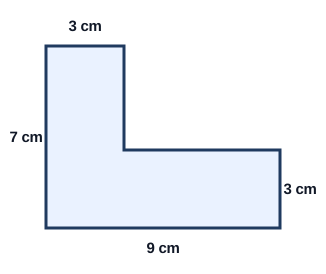
Text description of shape 1. Starting at the bottom-left corner and going anticlockwise, the sides are: side 1, 9 cm right (length shown); side 2, 3 cm up (length shown); side 3, 6 cm left (length not shown); side 4, 4 cm up (length not shown); side 5, 3 cm left (length shown); side 6, 7 cm down (length shown).
What is the perimeter of shape 1?
- A. 22 cm
- B. 29 cm
- C. 32 cm
- D. 39 cm
Question 2
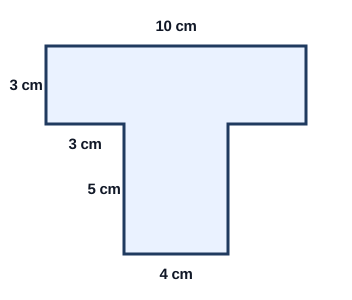
Text description of shape 2. Starting at the bottom-left corner of the stem and going anticlockwise, the sides are: side 1, 4 cm right (length shown); side 2, 5 cm up (length not shown); side 3, 3 cm right (length not shown); side 4, 3 cm up (length not shown); side 5, 10 cm left (length shown); side 6, 3 cm down (length shown); side 7, 3 cm right (length shown); side 8, 5 cm down (length shown).
What is the perimeter of shape 2?
- A. 31 cm
- B. 36 cm
- C. 25 cm
- D. 50 cm
Question 3
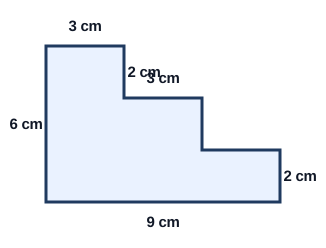
Text description of shape 3. Starting at the bottom-left corner and going anticlockwise, the sides are: side 1, 9 cm right (length shown); side 2, 2 cm up (length shown); side 3, 3 cm left (length not shown); side 4, 2 cm up (length not shown); side 5, 3 cm left (length shown); side 6, 2 cm up (length shown); side 7, 3 cm left (length shown); side 8, 6 cm down (length shown).
What is the perimeter of shape 3?
- A. 28 cm
- B. 25 cm
- C. 36 cm
- D. 30 cm
Question 4
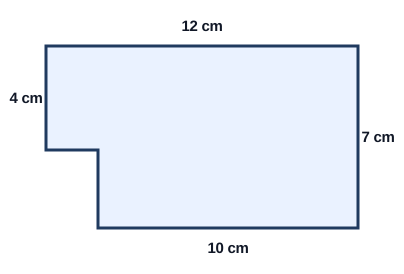
Text description of shape 4. Starting at the left end of the notch's top edge and going anticlockwise, the sides are: side 1, 2 cm right (length not shown); side 2, 3 cm down (length not shown); side 3, 10 cm right (length shown); side 4, 7 cm up (length shown); side 5, 12 cm left (length shown); side 6, 4 cm down (length shown).
What is the perimeter of shape 4?
- A. 38 cm
- B. 33 cm
- C. 35 cm
- D. 43 cm
Question 5
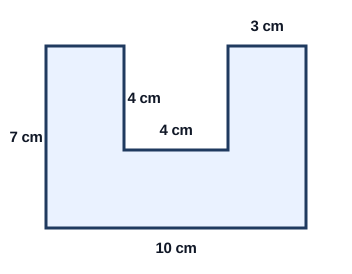
Text description of shape 5. Starting at the bottom-left corner and going anticlockwise, the sides are: side 1, 10 cm right (length shown); side 2, 7 cm up (length not shown); side 3, 3 cm left (length shown); side 4, 4 cm down (length not shown); side 5, 4 cm left (length shown); side 6, 4 cm up (length shown); side 7, 3 cm left (length not shown); side 8, 7 cm down (length shown).
What is the perimeter of shape 5?
- A. 54 cm
- B. 34 cm
- C. 28 cm
- D. 42 cm
Question 6
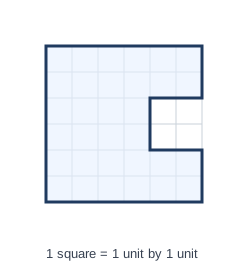
Text description of shape 6. Starting at the bottom-left corner and going anticlockwise, the sides are: side 1, 6 units right; side 2, 2 units up; side 3, 2 units left; side 4, 2 units up; side 5, 2 units right; side 6, 2 units up; side 7, 6 units left; side 8, 6 units down. Each grid square is 1 unit by 1 unit.
What is the perimeter of shape 6?
- A. 24 units
- B. 28 units
- C. 26 units
- D. 32 units
Question 7
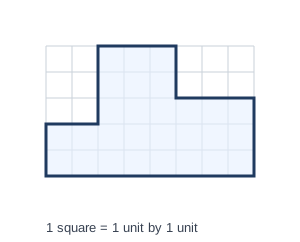
Text description of shape 7. Starting at the bottom-left corner and going anticlockwise, the sides are: side 1, 8 units right; side 2, 3 units up; side 3, 3 units left; side 4, 2 units up; side 5, 3 units left; side 6, 3 units down; side 7, 2 units left; side 8, 2 units down. Each grid square is 1 unit by 1 unit.
What is the perimeter of shape 7?
- A. 28 units
- B. 16 units
- C. 26 units
- D. 24 units
Question 8
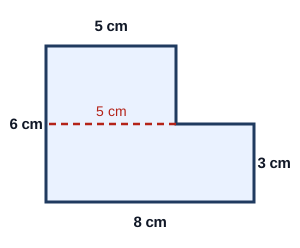
Text description of shape 8. Starting at the bottom-left corner and going anticlockwise, the sides are: side 1, 8 cm right (length shown); side 2, 3 cm up (length shown); side 3, 3 cm left (length not shown); side 4, 3 cm up (length not shown); side 5, 5 cm left (length shown); side 6, 6 cm down (length shown). A dashed line 5 cm long runs across the inside of the shape; it is not part of the boundary.
What is the perimeter of shape 8?
- A. 33 cm
- B. 22 cm
- C. 28 cm
- D. 39 cm
Answers with the boundary drawn
Each answer below lists the sides in the order you trace them, numbered from the start corner and moving anticlockwise. Open one at a time, after your child has committed to an answer.
Answer to question 1
Answer: C, 32 cm.
Trace from the bottom-left corner, anticlockwise: 1: 9 right; 2: 3 up; 3: 6 left; 4: 4 up; 5: 3 left; 6: 7 down.
9 + 3 + 6 + 4 + 3 + 7 = 32 cm.
Why the other options are wrong:
- Option A (22) adds only the four labelled sides (9 + 3 + 3 + 7).
- Option B (29) guesses the inner horizontal side is 3 cm, like the label beside it, instead of 9 − 3 = 6 cm.
- Option D (39) gives the area (9 × 7 − 6 × 4 = 39 square cm), not the distance around.
Answer to question 2
Answer: B, 36 cm.
Trace from the bottom-left corner of the stem, anticlockwise: 1: 4 right; 2: 5 up; 3: 3 right; 4: 3 up; 5: 10 left; 6: 3 down; 7: 3 right; 8: 5 down.
4 + 5 + 3 + 3 + 10 + 3 + 3 + 5 = 36 cm.
Why the other options are wrong:
- Option A (31) adds the right overhang and right bar side but forgets the right side of the stem (5 cm).
- Option C (25) adds only the five labelled sides.
- Option D (50) gives the area (10 × 3 + 4 × 5 = 50 square cm).
Answer to question 3
Answer: D, 30 cm.
Trace from the bottom-left corner, anticlockwise: 1: 9 right; 2: 2 up; 3: 3 left; 4: 2 up; 5: 3 left; 6: 2 up; 7: 3 left; 8: 6 down.
9 + 2 + 3 + 2 + 3 + 2 + 3 + 6 = 30 cm.
Why the other options are wrong:
- Option A (28) adds the missing 3 cm tread but forgets the missing 2 cm riser.
- Option B (25) adds only the six labelled sides.
- Option C (36) gives the area (18 + 12 + 6 = 36 square cm).
Answer to question 4
Answer: A, 38 cm.
Trace from the left end of the notch's top edge, anticlockwise: 1: 2 right; 2: 3 down; 3: 10 right; 4: 7 up; 5: 12 left; 6: 4 down.
2 + 3 + 10 + 7 + 12 + 4 = 38 cm.
Why this equals the rectangle. The surrounding rectangle is 12 by 7, so its perimeter is 2 × (12 + 7) = 38 cm. The notch's 2 cm and 3 cm sides are exactly the lengths the bottom and left edges lost, so the boundary is no longer and no shorter than the rectangle's. That is why the rectangle's perimeter is already the answer, and why adding the notch on top (option D) counts those lengths twice.
Why the other options are wrong:
- Option B (33) adds only the four labelled sides.
- Option C (35) finds the 2 cm gap but forgets the 3 cm gap.
- Option D (43) adds the notch's two sides on top of the whole rectangle's perimeter (38 + 2 + 3).
Answer to question 5
Answer: D, 42 cm.
Trace from the bottom-left corner, anticlockwise: 1: 10 right; 2: 7 up; 3: 3 left; 4: 4 down; 5: 4 left; 6: 4 up; 7: 3 left; 8: 7 down.
10 + 7 + 3 + 4 + 4 + 4 + 3 + 7 = 42 cm.
Why the other options are wrong:
- Option A (54) gives the area (10 × 7 − 4 × 4 = 54 square cm).
- Option B (34) gives the perimeter of the surrounding rectangle and ignores the slot's three sides.
- Option C (28) adds only the five labelled sides.
Answer to question 6
Answer: B, 28 units.
Trace from the bottom-left corner, anticlockwise: 1: 6 right; 2: 2 up; 3: 2 left; 4: 2 up; 5: 2 right; 6: 2 up; 7: 6 left; 8: 6 down.
6 + 2 + 2 + 2 + 2 + 2 + 6 + 6 = 28 units.
Why the other options are wrong:
- Option A (24) gives the perimeter of the surrounding 6 by 6 square.
- Option C (26) counts the slot's two walls but misses its back.
- Option D (32) gives the area (36 − 4 = 32 square units).
Answer to question 7
Answer: C, 26 units.
Trace from the bottom-left corner, anticlockwise: 1: 8 right; 2: 3 up; 3: 3 left; 4: 2 up; 5: 3 left; 6: 3 down; 7: 2 left; 8: 2 down.
8 + 3 + 3 + 2 + 3 + 3 + 2 + 2 = 26 units.
Why the other options are wrong:
- Option A (28) gives the area (4 + 15 + 9 = 28 square units).
- Option B (16) adds only the horizontal sides (8 + 3 + 3 + 2).
- Option D (24) misses the short 2-unit vertical side on the left.
Answer to question 8
Answer: C, 28 cm.
Trace from the bottom-left corner, anticlockwise: 1: 8 right; 2: 3 up; 3: 3 left; 4: 3 up; 5: 5 left; 6: 6 down.
8 + 3 + 3 + 3 + 5 + 6 = 28 cm.
The dashed line is 5 cm long but sits inside the shape. It divides the shape into two rectangles and is not part of the boundary.
Why the other options are wrong:
- Option A (33) adds the internal line (28 + 5).
- Option B (22) adds only the four labelled boundary sides.
- Option D (39) gives the area (24 + 15 = 39 square cm).
What mistake patterns should we look for?
Tally which kind of error came up. Each one needs a different fix.
| Pattern | Seen in | What to practise next |
|---|---|---|
| Added only the labelled sides | Questions 1, 2, 3, 4, 5, 8 | Number every side on the drawing before adding anything |
| Counted the line inside the shape | Question 8 | Colour the outside boundary in one pen, then add only that |
| Gave the area instead of the perimeter | Questions 1, 2, 3, 5, 6, 7, 8 | Say the unit: "cm" for the distance around, "square cm" for the space inside |
| Used a wrong missing length | Question 1 | Write the subtraction beside the missing side, such as 9 − 3 = 6 |
| Left out a side when adding | Questions 2, 3, 4, 5, 6, 7 | Tick each numbered side as you add it, and check the count of ticks against the count of sides |
Can my child draw two shapes with the same perimeter?
On grid paper, draw two different shapes that each have a perimeter of 20 units. Use at least one shape that is not a rectangle.
Self-check: trace each boundary and number the sides. A 6 by 4 rectangle works (6 + 4 + 6 + 4 = 20). So does an L-shape cut from a 6 by 4 rectangle, because a corner cut-out leaves the perimeter unchanged. If one of your shapes gives 19 or 21, a side was counted twice or missed.
What should we do after this set?
- If two or more answers showed the same pattern in the table, repeat only those questions tomorrow with new shapes. Do not sit a full test yet.
- For mixed OC practice with worked solutions, open the OC practice tests guide.
- For full papers to sit under time, see the OC past papers page.
- For a mixed set that includes one perimeter question, try the Year 5 maths worksheets.
- The free mock tests need a free classroom account. Create one only when your child is ready for a timed sitting.
- If you want a structured set of full OC tests after that, see what the OC course includes and check it matches your child's entry year before buying.
Sources and review
Official source (checked 2026-10-15): NSW Department of Education, Opportunity Class practice tests: the test is computer-based with three multiple-choice sections (Reading, Mathematical Reasoning, Thinking Skills).
Where the questions came from: all eight shapes, both worked shapes and every answer are original Braintree Coaching Australia material written for this page. None is taken from an official or third-party paper.
Author: James Rush, content writer, Braintree Coaching Australia.
Answer check: every perimeter was computed by a script from the drawn coordinates and checked against the answer key. A named teacher review has not yet been recorded for this set. If you find an error, please tell us.
Last updated: 2026-10-15.
Questions parents ask about this resource
Sources and review
- Answer check not yet recorded.
- Named teacher review not yet recorded.
Related practice resources
Continue your preparation
NSW Opportunity Class placement test preparation
Browse all Braintree Coaching Australia practice resources to find practice papers and study guides for your child's exam.