
HAST shape transformations: 8 two-rule sequences with answers
Eight original Braintree Coaching Australia shape sequences for children practising abstract reasoning, each drawn as a figure with a text description of every frame, two rules per sequence, rising difficulty and a frame-by-frame solution trail. Skill practice pitched at the Year 7 entry band, not ACER test items.
Last updated
About this resource
Quick Answer
In a shape sequence, name what changes from one frame to the next, one feature at a time: turn, flip, shading, number or size. Expect two rules running together, and test your answer against both. This page from Braintree Coaching Australia has eight original shape sequences for a child practising abstract reasoning, each drawn as a figure with a text description of every frame and a frame-by-frame answer trail. It is free and needs no sign-up.
Who is this practice for, and does my school's HAST include abstract reasoning?
First, confirm that your child's school package includes abstract reasoning. ACER's HAST is chosen school by school. ACER's student information bulletin says there are either three or four tests depending on the package the school selects, and that a three-test package has Written Expression or Abstract Reasoning, not both. If abstract reasoning is not in your school's package, skip this page and spend the time on the components that are.
ACER describes abstract reasoning as a non-verbal test in which the student identifies and completes picture sequences and patterns. This set is skill practice for that kind of thinking, not a copy of ACER's items, and we do not claim that the figures here resemble ACER's booklet. It is pitched at a child entering Year 7, usually in Year 6 now, who can describe a turn or a flip in words. For ACER's own samples, see ACER's HAST page and the student information bulletin it links to.
All eight sequences use the same figure, an L shape with a long bar and a short foot, so the only thing to work out is what is being done to it. Drawings are not to scale, and the dots are always counted one by one.
How do we find two rules in one sequence? A worked trail
Work through one feature at a time, on paper. Here is a sequence described in words (it is not one of the eight, so there is no figure; sketch it if it helps).
- Frame 1: bar up, foot right, large, black.
- Frame 2: bar right, foot down, a little smaller, black.
- Frame 3: bar down, foot left, smaller again, black.
- Turn? From frame 1 to 2 the bar moved from up to right. That is a quarter turn clockwise. Frame 2 to 3: right to down, the same quarter turn clockwise. Rule 1 holds.
- Flip? A flip would swap the foot to the other side of the bar without turning it. The foot stayed on the same side relative to the bar, so there is no flip.
- Shading? Black, black, black. No change.
- Number? No dots in any frame. No change.
- Size? Each frame is a step smaller. That is rule 2.
So the two rules are: turn a quarter clockwise, and shrink one step. Frame 4 would be bar left, foot up, smaller again. A good habit: before looking at the options, say both rules aloud, then draw the next frame yourself.
The sequences
Work on paper. The eight run from easier to harder. In the first three the two rules change different features. From question 5 the rules interact, and from question 6 they repeat on different cycles. Each figure has a text description of every frame and every option underneath it.
Question 1
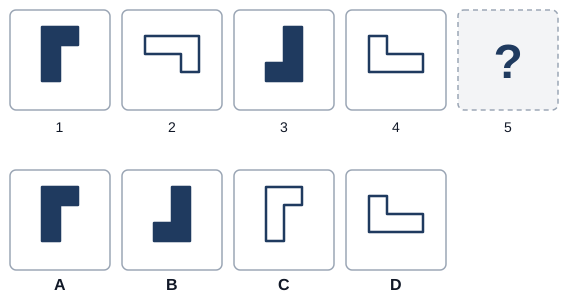
Text description of sequence 1.
- Frame 1: the long bar points up and the short foot points right, filled black, no dots.
- Frame 2: the long bar points right and the short foot points down, outlined and white, no dots.
- Frame 3: the long bar points down and the short foot points left, filled black, no dots.
- Frame 4: the long bar points left and the short foot points up, outlined and white, no dots.
- Frame 5: missing.
Which option, A to D, belongs in frame 5?
- A. The long bar points up and the short foot points right, filled black, no dots.
- B. The long bar points down and the short foot points left, filled black, no dots.
- C. The long bar points up and the short foot points right, outlined and white, no dots.
- D. The long bar points left and the short foot points up, outlined and white, no dots.
Question 2
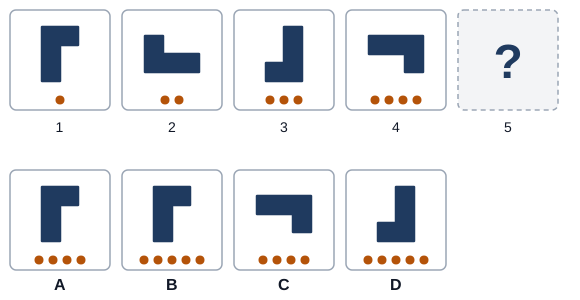
Text description of sequence 2.
- Frame 1: the long bar points up and the short foot points right, filled black, 1 dot.
- Frame 2: the long bar points left and the short foot points up, filled black, 2 dots.
- Frame 3: the long bar points down and the short foot points left, filled black, 3 dots.
- Frame 4: the long bar points right and the short foot points down, filled black, 4 dots.
- Frame 5: missing.
Which option, A to D, belongs in frame 5?
- A. The long bar points up and the short foot points right, filled black, 4 dots.
- B. The long bar points up and the short foot points right, filled black, 5 dots.
- C. The long bar points right and the short foot points down, filled black, 4 dots.
- D. The long bar points down and the short foot points left, filled black, 5 dots.
Question 3
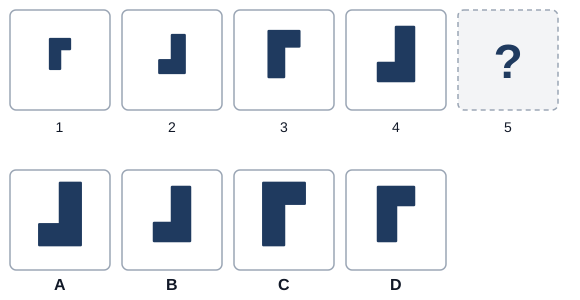
Text description of sequence 3.
- Frame 1: the long bar points up and the short foot points right, filled black, no dots, drawn at 55% size.
- Frame 2: the long bar points down and the short foot points left, filled black, no dots, drawn at 70% size.
- Frame 3: the long bar points up and the short foot points right, filled black, no dots, drawn at 85% size.
- Frame 4: the long bar points down and the short foot points left, filled black, no dots, drawn at 100% size.
- Frame 5: missing.
Which option, A to D, belongs in frame 5?
- A. The long bar points down and the short foot points left, filled black, no dots, drawn at 115% size.
- B. The long bar points down and the short foot points left, filled black, no dots, drawn at 100% size.
- C. The long bar points up and the short foot points right, filled black, no dots, drawn at 115% size.
- D. The long bar points up and the short foot points right, filled black, no dots, drawn at 100% size.
Question 4
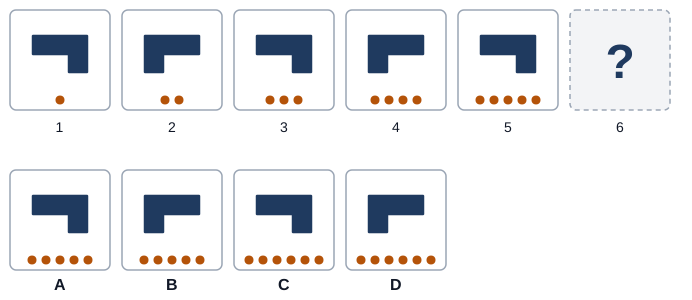
Text description of sequence 4.
- Frame 1: the long bar points right and the short foot points down, filled black, 1 dot.
- Frame 2: the long bar points left and the short foot points down, filled black, 2 dots.
- Frame 3: the long bar points right and the short foot points down, filled black, 3 dots.
- Frame 4: the long bar points left and the short foot points down, filled black, 4 dots.
- Frame 5: the long bar points right and the short foot points down, filled black, 5 dots.
- Frame 6: missing.
Which option, A to D, belongs in frame 6?
- A. The long bar points right and the short foot points down, filled black, 5 dots.
- B. The long bar points left and the short foot points down, filled black, 5 dots.
- C. The long bar points right and the short foot points down, filled black, 6 dots.
- D. The long bar points left and the short foot points down, filled black, 6 dots.
Question 5
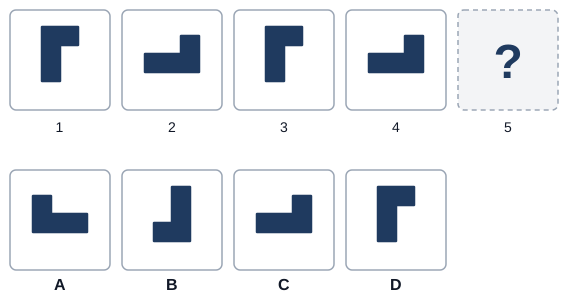
Text description of sequence 5.
- Frame 1: the long bar points up and the short foot points right, filled black, no dots.
- Frame 2: the long bar points right and the short foot points up, filled black, no dots.
- Frame 3: the long bar points up and the short foot points right, filled black, no dots.
- Frame 4: the long bar points right and the short foot points up, filled black, no dots.
- Frame 5: missing.
Which option, A to D, belongs in frame 5?
- A. The long bar points left and the short foot points up, filled black, no dots.
- B. The long bar points down and the short foot points left, filled black, no dots.
- C. The long bar points right and the short foot points up, filled black, no dots.
- D. The long bar points up and the short foot points right, filled black, no dots.
Question 6
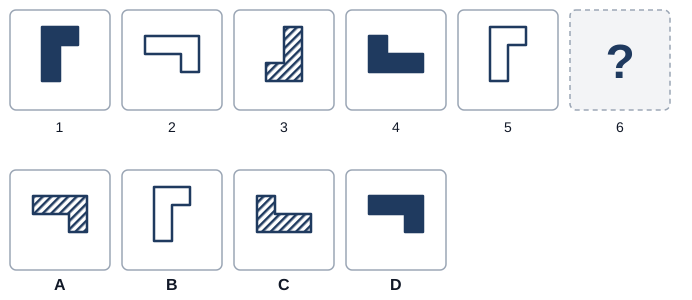
Text description of sequence 6.
- Frame 1: the long bar points up and the short foot points right, filled black, no dots.
- Frame 2: the long bar points right and the short foot points down, outlined and white, no dots.
- Frame 3: the long bar points down and the short foot points left, striped, no dots.
- Frame 4: the long bar points left and the short foot points up, filled black, no dots.
- Frame 5: the long bar points up and the short foot points right, outlined and white, no dots.
- Frame 6: missing.
Which option, A to D, belongs in frame 6?
- A. The long bar points right and the short foot points down, striped, no dots.
- B. The long bar points up and the short foot points right, outlined and white, no dots.
- C. The long bar points left and the short foot points up, striped, no dots.
- D. The long bar points right and the short foot points down, filled black, no dots.
Question 7
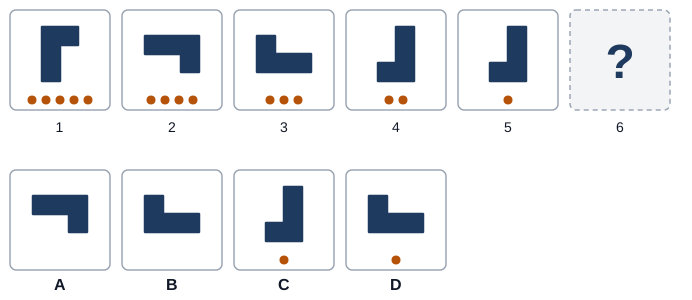
Text description of sequence 7.
- Frame 1: the long bar points up and the short foot points right, filled black, 5 dots.
- Frame 2: the long bar points right and the short foot points down, filled black, 4 dots.
- Frame 3: the long bar points left and the short foot points up, filled black, 3 dots.
- Frame 4: the long bar points down and the short foot points left, filled black, 2 dots.
- Frame 5: the long bar points down and the short foot points left, filled black, 1 dot.
- Frame 6: missing.
Which option, A to D, belongs in frame 6?
- A. The long bar points right and the short foot points down, filled black, no dots.
- B. The long bar points left and the short foot points up, filled black, no dots.
- C. The long bar points down and the short foot points left, filled black, 1 dot.
- D. The long bar points left and the short foot points up, filled black, 1 dot.
Question 8
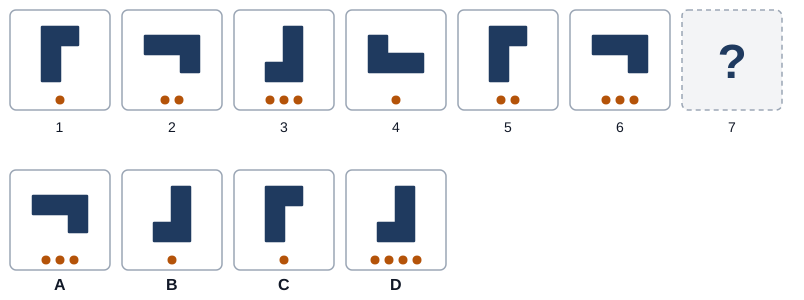
Text description of sequence 8.
- Frame 1: the long bar points up and the short foot points right, filled black, 1 dot.
- Frame 2: the long bar points right and the short foot points down, filled black, 2 dots.
- Frame 3: the long bar points down and the short foot points left, filled black, 3 dots.
- Frame 4: the long bar points left and the short foot points up, filled black, 1 dot.
- Frame 5: the long bar points up and the short foot points right, filled black, 2 dots.
- Frame 6: the long bar points right and the short foot points down, filled black, 3 dots.
- Frame 7: missing.
Which option, A to D, belongs in frame 7?
- A. The long bar points right and the short foot points down, filled black, 3 dots.
- B. The long bar points down and the short foot points left, filled black, 1 dot.
- C. The long bar points up and the short foot points right, filled black, 1 dot.
- D. The long bar points down and the short foot points left, filled black, 4 dots.
Answers with a frame-by-frame trail
Open an answer only after your child has chosen one and said both rules aloud. Each trail names both rules and then shows how every frame follows from the one before.
Answer to question 1
Answer: A.
Rule 1: each frame is the last one turned a quarter clockwise (up, right, down, left). Rule 2: the shading alternates (black, white, black, white).
Solution trail:
- Frame 1 to frame 2, both rules applied: the long bar points right and the short foot points down, outlined and white, no dots.
- Frame 2 to frame 3, both rules applied: the long bar points down and the short foot points left, filled black, no dots.
- Frame 3 to frame 4, both rules applied: the long bar points left and the short foot points up, outlined and white, no dots.
- Frame 4 to frame 5, both rules applied: the long bar points up and the short foot points right, filled black, no dots.
Why the other options are wrong:
- Option B: The turn went anticlockwise instead of clockwise, with the shading right.
- Option C: The quarter turn is right but the shading did not change.
- Option D: The last frame again, with neither rule applied.
Answer to question 2
Answer: B.
Rule 1: each frame is the last one turned a quarter anticlockwise (up, left, down, right). Rule 2: one dot is added each frame (1, 2, 3, 4).
Solution trail:
- Frame 1 to frame 2, both rules applied: the long bar points left and the short foot points up, filled black, 2 dots.
- Frame 2 to frame 3, both rules applied: the long bar points down and the short foot points left, filled black, 3 dots.
- Frame 3 to frame 4, both rules applied: the long bar points right and the short foot points down, filled black, 4 dots.
- Frame 4 to frame 5, both rules applied: the long bar points up and the short foot points right, filled black, 5 dots.
Why the other options are wrong:
- Option A: The anticlockwise turn is right but the dot count stayed the same.
- Option C: The last frame again, with neither rule applied.
- Option D: The turn went clockwise instead of anticlockwise, with the dots right.
Answer to question 3
Answer: C.
Rule 1: each frame is the last one turned a half-turn, so the bar swaps between up and down. Rule 2: the figure grows one step each frame (55%, 70%, 85%, 100%).
Solution trail:
- Frame 1 to frame 2, both rules applied: the long bar points down and the short foot points left, filled black, no dots, drawn at 70% size.
- Frame 2 to frame 3, both rules applied: the long bar points up and the short foot points right, filled black, no dots, drawn at 85% size.
- Frame 3 to frame 4, both rules applied: the long bar points down and the short foot points left, filled black, no dots, drawn at 100% size.
- Frame 4 to frame 5, both rules applied: the long bar points up and the short foot points right, filled black, no dots, drawn at 115% size.
Why the other options are wrong:
- Option A: The figure was not turned, with the size right.
- Option B: The last frame again, with neither rule applied.
- Option D: The half-turn is right but the size did not grow.
Answer to question 4
Answer: D.
Rule 1: each frame is the last one flipped left to right, so the bar swaps between right and left while the foot stays down. Rule 2: one dot is added each frame (1 to 5).
Solution trail:
- Frame 1 to frame 2, both rules applied: the long bar points left and the short foot points down, filled black, 2 dots.
- Frame 2 to frame 3, both rules applied: the long bar points right and the short foot points down, filled black, 3 dots.
- Frame 3 to frame 4, both rules applied: the long bar points left and the short foot points down, filled black, 4 dots.
- Frame 4 to frame 5, both rules applied: the long bar points right and the short foot points down, filled black, 5 dots.
- Frame 5 to frame 6, both rules applied: the long bar points left and the short foot points down, filled black, 6 dots.
Why the other options are wrong:
- Option A: The last frame again, with neither rule applied.
- Option B: The flip is right but the dot count stayed the same.
- Option C: The figure was not flipped, with the dots right.
Answer to question 5
Answer: D.
Rule 1: flip the last frame left to right. Rule 2: turn it a quarter clockwise. Together the bar and foot swap places each frame (bar up, foot right; bar right, foot up).
Solution trail:
- Frame 1 to frame 2, both rules applied: the long bar points right and the short foot points up, filled black, no dots.
- Frame 2 to frame 3, both rules applied: the long bar points up and the short foot points right, filled black, no dots.
- Frame 3 to frame 4, both rules applied: the long bar points right and the short foot points up, filled black, no dots.
- Frame 4 to frame 5, both rules applied: the long bar points up and the short foot points right, filled black, no dots.
Why the other options are wrong:
- Option A: The figure was flipped but not turned.
- Option B: The figure was flipped then turned anticlockwise, not clockwise.
- Option C: The last frame again, with neither rule applied.
Answer to question 6
Answer: A.
Rule 1: each frame is the last one turned a quarter clockwise. Rule 2: the shading cycles through three states (black, white, striped, then black again). The turn repeats every 4 frames and the shading every 3.
Solution trail:
- Frame 1 to frame 2, both rules applied: the long bar points right and the short foot points down, outlined and white, no dots.
- Frame 2 to frame 3, both rules applied: the long bar points down and the short foot points left, striped, no dots.
- Frame 3 to frame 4, both rules applied: the long bar points left and the short foot points up, filled black, no dots.
- Frame 4 to frame 5, both rules applied: the long bar points up and the short foot points right, outlined and white, no dots.
- Frame 5 to frame 6, both rules applied: the long bar points right and the short foot points down, striped, no dots.
Why the other options are wrong:
- Option B: The last frame again, with neither rule applied.
- Option C: The turn went anticlockwise, with the shading right.
- Option D: The shading went backwards through the cycle, with the turn right.
Answer to question 7
Answer: B.
Rule 1: the turn grows by a quarter each frame (a quarter, a half, three quarters, a full turn which looks like no turn, then a quarter again). Rule 2: one dot fewer each frame (5 down to 1, then none).
Solution trail:
- Frame 1 to frame 2, both rules applied: the long bar points right and the short foot points down, filled black, 4 dots.
- Frame 2 to frame 3, both rules applied: the long bar points left and the short foot points up, filled black, 3 dots.
- Frame 3 to frame 4, both rules applied: the long bar points down and the short foot points left, filled black, 2 dots.
- Frame 4 to frame 5, both rules applied: the long bar points down and the short foot points left, filled black, 1 dot.
- Frame 5 to frame 6, both rules applied: the long bar points left and the short foot points up, filled black, no dots.
Why the other options are wrong:
- Option A: The turn is the wrong amount (three quarters), with the dots right.
- Option C: The last frame again, with neither rule applied.
- Option D: The turn is right but the dot count did not go down.
Answer to question 8
Answer: B.
Rule 1: each frame is the last one turned a quarter clockwise. Rule 2: the dots count 1, 2, 3 and then start again at 1. The turn repeats every 4 frames and the count every 3.
Solution trail:
- Frame 1 to frame 2, both rules applied: the long bar points right and the short foot points down, filled black, 2 dots.
- Frame 2 to frame 3, both rules applied: the long bar points down and the short foot points left, filled black, 3 dots.
- Frame 3 to frame 4, both rules applied: the long bar points left and the short foot points up, filled black, 1 dot.
- Frame 4 to frame 5, both rules applied: the long bar points up and the short foot points right, filled black, 2 dots.
- Frame 5 to frame 6, both rules applied: the long bar points right and the short foot points down, filled black, 3 dots.
- Frame 6 to frame 7, both rules applied: the long bar points down and the short foot points left, filled black, 1 dot.
Why the other options are wrong:
- Option A: The last frame again, with neither rule applied.
- Option C: The turn went anticlockwise, with the count right.
- Option D: The turn is right but the count kept growing to 4 instead of starting again at 1.
What mistake patterns should we look for?
Tally which kind of wrong option came up. Each one needs a different fix.
| Pattern | Seen in | What to practise next |
|---|---|---|
| Found one rule and stopped | Questions 1 to 8 (every set has an option that gets one rule right) | Say both rules aloud before looking at the options |
| Reversed the turn | Questions 1, 2, 5, 6, 8 | Stand a pencil on the page and turn it, then check clockwise against the frames |
| Skipped a rule on the last step | Questions 1, 2, 3, 4, 5, 7 | Write "turn" and "shade" (or "count", "size") in two columns and tick both for every step |
| Repeated the last frame | Questions 1 to 8 | Check each option against the frame before the gap: if nothing changed, no rule was applied |
| Lost the cycle | Questions 6, 8 | Write the count or shading for every frame in a row, then continue the row |
Can my child fill a missing middle frame?
Use question 6 again. Cover frame 3 with your hand, so that only frames 1, 2, 4 and 5 show. Ask your child to say what frame 3 must look like, and then to draw it.
Self-check: frame 2 has the bar pointing right and frame 4 has it pointing left, so frame 3 sits a quarter turn on from frame 2 with the bar pointing down and the foot pointing left. For the shading, frame 1 is black, frame 2 is white, frame 4 is black again and frame 5 is white again, so the pattern repeats every three frames and frame 3 holds the third state, the striped one from the question. Frame 3 is striped. Uncover it to check. If your child gets the turn but not the shading, they treated the shading as two states, not three.
Which HAST level should we practise next?
Choose by the year your child will be in when sitting, and only after you have confirmed with the school that abstract reasoning is in their package. These bands are our own entry-year wording, the same split as on our HAST exam preparation page and HAST practice resources hub.
| Entry band | Course outline |
|---|---|
| Year 7 entry | HAST Year 7 course |
| Years 8–9 entry | HAST Year 8–9 course |
| Years 10–11 entry | HAST Year 10–11 course |
Check what each course page includes before you buy. Other things to do next:
- For how to organise a week of HAST practice, see the HAST practice resources hub.
- For the component names and package choices, see the HAST test format guide.
- For sample questions across the other components, try the HAST sample questions.
- The free mock tests need a free classroom account. Create one only when your child is ready for a timed sitting.
Sources and review
Official source (checked 2026-10-15): ACER, HAST and its student information bulletin for Secondary: schools choose a test package of three or four tests; abstract reasoning is a non-verbal test of picture sequences and patterns.
Where the questions came from: all eight sequences, the worked trail and every answer are original Braintree Coaching Australia material written for this page. None is taken from an official or third-party paper.
Author: James Rush, content writer, Braintree Coaching Australia.
Answer check: every sequence and option was generated by a script that applies both rules to the first frame and confirms that the four options are four different figures, so each question has one answer. A named teacher review has not yet been recorded for this set. If you find an error, please tell us.
Last updated: 2026-10-15.
Questions parents ask about this resource
Sources and review
- Answer check not yet recorded.
- Named teacher review not yet recorded.
Companion resources
Continue your preparation
HAST high-ability selection test preparation
Browse all Braintree Coaching Australia practice resources to find practice papers and study guides for your child's exam.